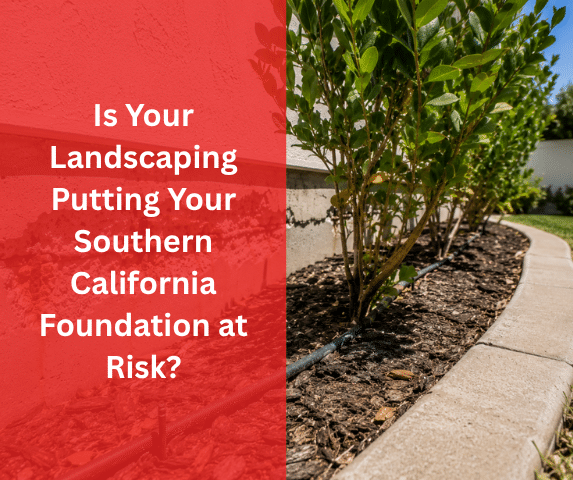
Is Your Landscaping Putting Your Southern California Foundation at Risk?
Landscaping is a major part of many Southern California homes. Lawns, trees, shrubs, gardens, and decorative planting areas can improve curb appeal and make outdoor spaces more enjoyable.
Keeping that landscaping healthy often requires irrigation.
While there's nothing unusual about watering your yard, homeowners should pay attention to how landscaping and irrigation affect conditions immediately around the foundation.
Water repeatedly collecting near the house, irrigation problems, and changes to drainage can all be reasons to take a closer look at what's happening around your home.
Where Does Your Irrigation Water Go?
When an irrigation system operates correctly, water should reach the areas it's intended to water.
But irrigation systems don't remain unchanged forever.
Sprinkler heads move or break. Drip lines leak. Emitters are added. Plants grow. New landscaping is installed.
All of those changes can affect where water ends up.
Periodically checking the system while it's running can help you identify areas where water is reaching the house or collecting close to the foundation.
Be Careful When Changing Landscaping Near the Foundation
Installing a new garden or redesigning your landscaping may seem unrelated to foundation repair, but changes around the perimeter of a house can affect how water moves across the property.
Consider drainage when adding soil, decorative materials, planting areas, or other landscaping near the house.
Ideally, landscaping shouldn't create areas where irrigation or other water repeatedly collects against the structure.
Homeowners should also avoid allowing landscaping to completely obscure the exposed foundation. Being able to periodically see the stem wall makes it much easier to notice cracks or deterioration.
Don't Ignore Irrigation Leaks
Some irrigation leaks announce themselves with a geyser in the front yard.
Others are far less dramatic.
A damaged underground line or emitter may continually introduce water to one area without being immediately noticeable.
Pay attention to unusual wet spots, erosion, unexpectedly healthy plant growth, or areas that remain damp compared with the rest of the yard.
If the wet area is close to your home, inspect the visible foundation as well.
Check Your Foundation During Routine Yard Maintenance
You don't need to diagnose foundation problems yourself. But knowing what your foundation normally looks like can make changes easier to recognize.
When maintaining your landscaping, periodically look at the exposed concrete around your house.
Things worth having evaluated can include:
-
New foundation cracks
-
Horizontal cracks along the stem wall
-
Cracks that are getting larger
-
Concrete spalling or flaking
-
Rust-colored staining
-
Exposed reinforcing steel
-
Other visible changes to the foundation
These symptoms don't all have the same cause, which is why an inspection can be more useful than trying to determine the problem based on appearance alone.
Keep Plants From Hiding Your Stem Wall
Dense landscaping can make inspecting a foundation difficult.
Shrubs and other plants placed immediately against the house may conceal the stem wall, allowing cracks or deteriorating concrete to go unnoticed.
Maintaining enough visibility around the exterior of your home makes it easier to spot changes early.
This can be especially useful when watching for stem wall cracks and concrete spalling.
What About Sprinklers Hitting the Foundation?
Sprinkler overspray deserves particular attention because repeated moisture exposure against a concrete stem wall can contribute to conditions that allow the reinforcing steel inside to corrode.
Over time, corrosion around the rebar can contribute to cracking and concrete spalling.
We've covered the relationship between sprinkler overspray, rebar corrosion, and stem wall repair separately because the process can occur over many years — and visible damage may not appear until long after the original sprinkler problem has been corrected.
For general landscaping maintenance, the takeaway is straightforward: irrigation should water your landscaping, not your house.
Landscaping Is Only One Part of the Foundation Picture
If you've discovered a crack while trimming shrubs or working around your landscaping, don't automatically assume irrigation caused it.
Foundation cracks can develop for different reasons.
Instead, consider the crack a reason to learn more about what's happening.
A professional foundation inspection can help evaluate the affected area and determine whether additional attention or foundation repair is appropriate.
Schedule a Foundation Inspection in Southern California
Keeping an eye on your irrigation, landscaping, drainage, and visible foundation can help you recognize changes around your home.
If you're seeing foundation cracks, stem wall cracks, deteriorating concrete, concrete spalling, or other potential signs of foundation problems, Saber Foundation & Concrete Repair can evaluate the affected areas.
Schedule a foundation inspection with Saber Foundation & Concrete Repair to find out what's happening and whether foundation or stem wall repair may be appropriate for your Southern California home.
